Stop guessing which prompts matter.
Track the ones that do.
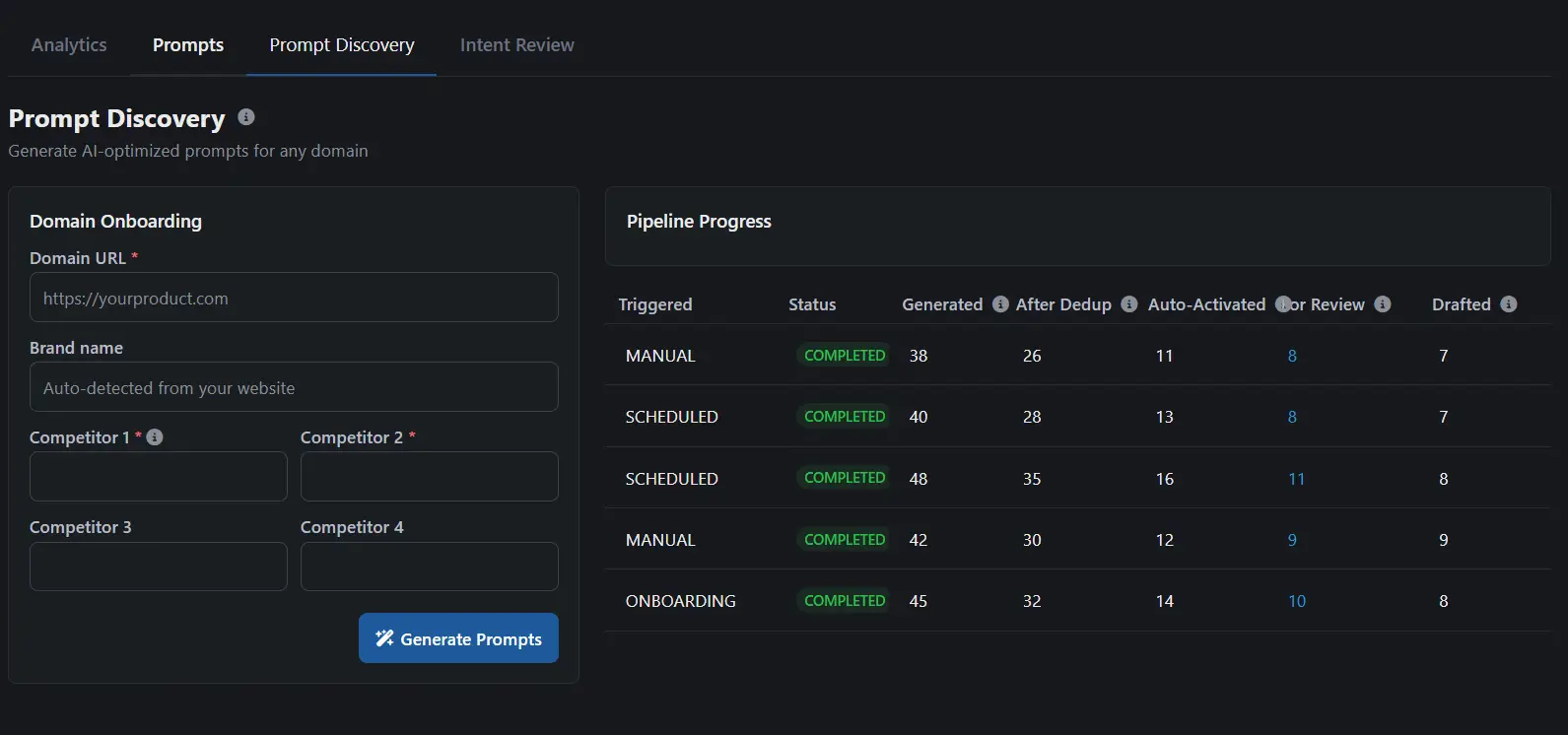
Prompt Discovery crawls your domain, builds a fingerprint of your positioning, and generates dozens of scored prompt intents automatically. Then monitors your citation status across up to 7 supported AI engines, every week.
From zero prompts to a scored, prioritized list in under 5 minutes.
You provide your domain URL and 2–3 competitors. Rankwize does the rest.
The pipeline crawls your site, extracts a structured fingerprint of your positioning and products, indexes your content library, then generates prompt intents from two sources: proven template families (buying decisions, competitor comparisons, category definitions) and AI ideation for ICP-specific queries that templates can't cover.
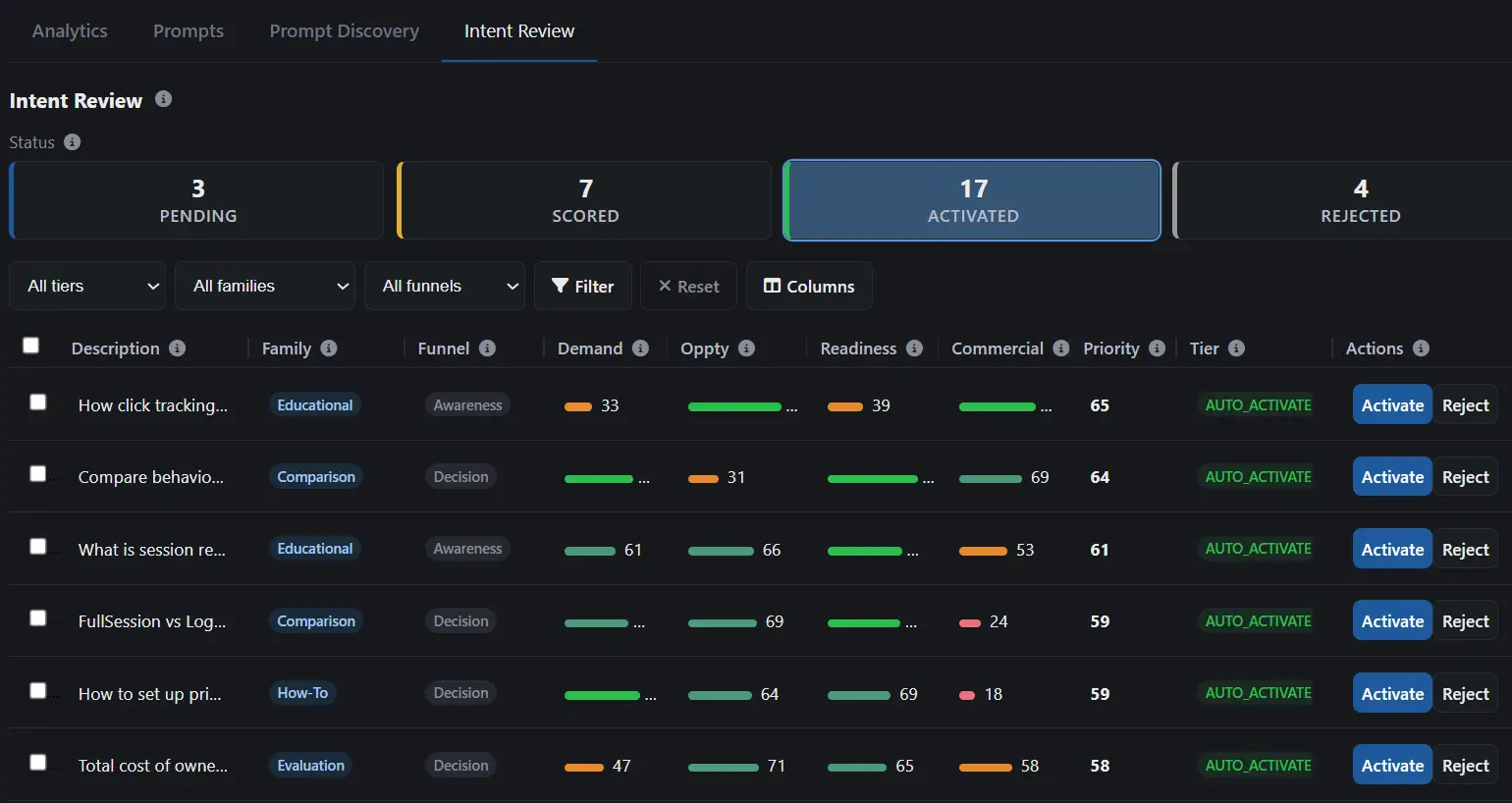
Every intent is scored on four independent factors: demand evidence (is anyone actually searching this?), citation opportunity (are competitors being cited while you're absent?), content readiness (do you already have a page that could win?), and commercial value (does this prompt signal buying behavior?).
High-scoring intents are auto-activated. Mid-range intents go to your review queue. Low-confidence intents are saved as drafts. You control what gets monitored. The system ensures you're not guessing.
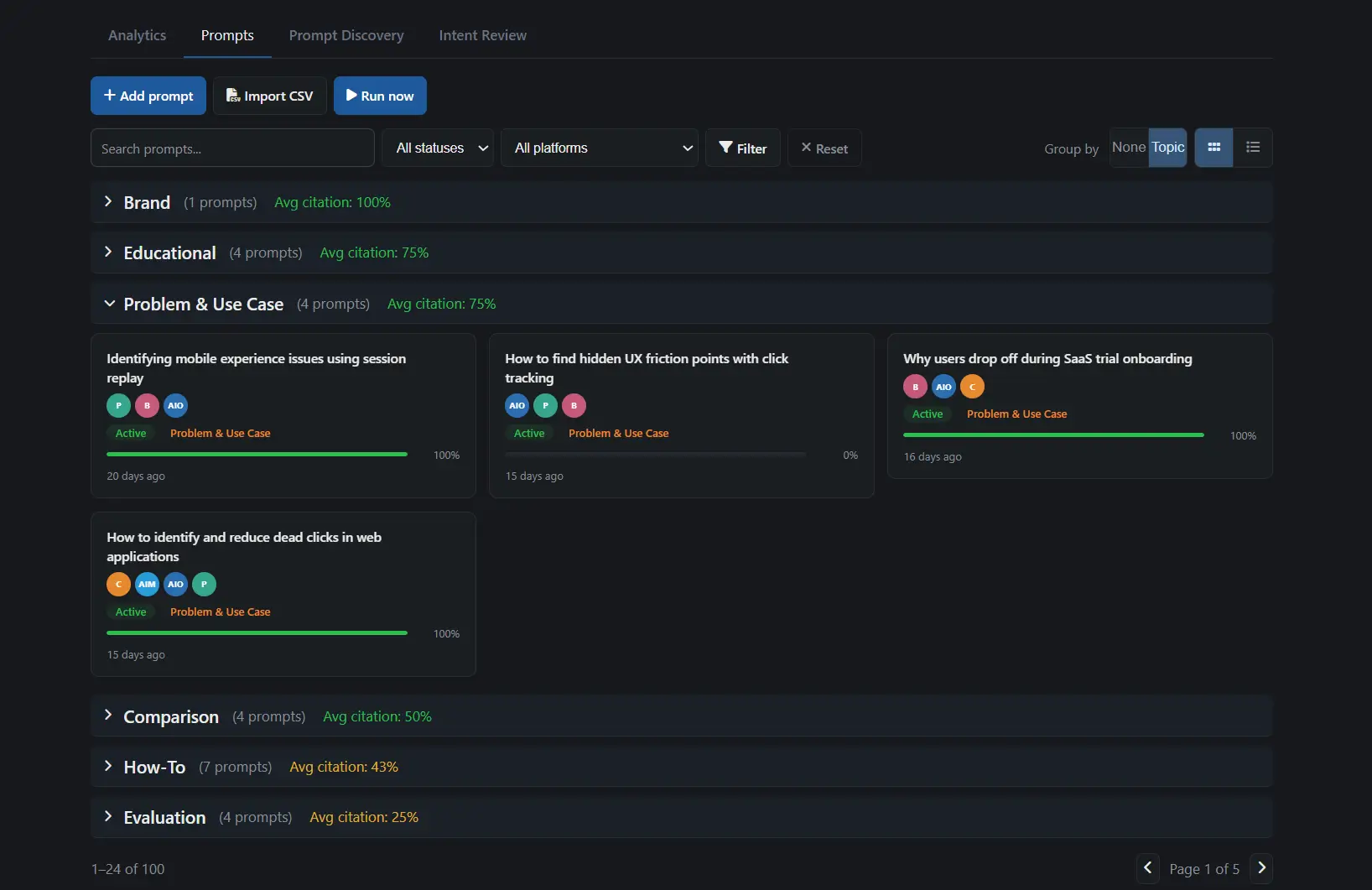
Up to 7 AI engines. Every prompt. Every week.
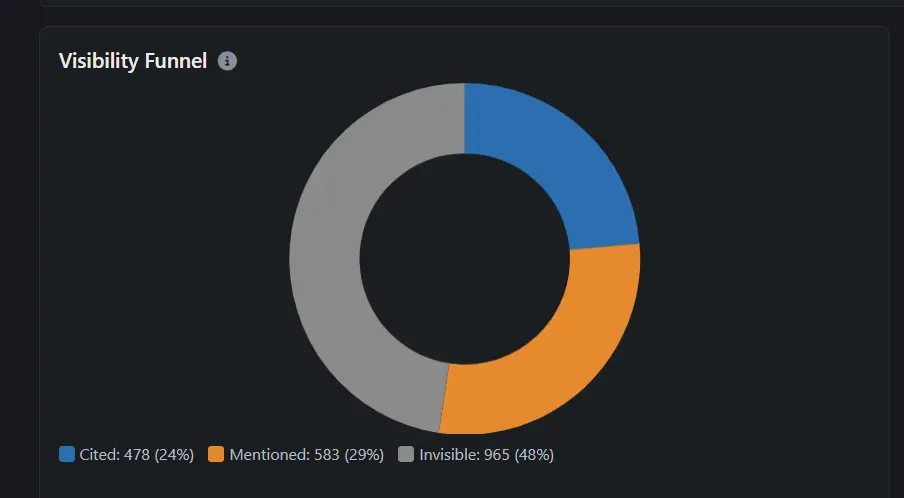
Rankwize monitors your citations across Google AI Overviews, ChatGPT, Perplexity, Google AI Mode, and Copilot — with Claude available as an add-on and Gemini coming soon. For each prompt on each platform, you see one of three results: cited (your URL was linked), mentioned (your brand appeared but wasn't linked), or invisible (you didn't appear at all).
Results are platform-specific because platform behavior differs. Cited on Perplexity, invisible on ChatGPT, mentioned-but-not-linked on Google AI Mode — three different problems requiring three different responses. Other tools aggregate these into one number. Rankwize shows you each one.
Spot drops before they compound.
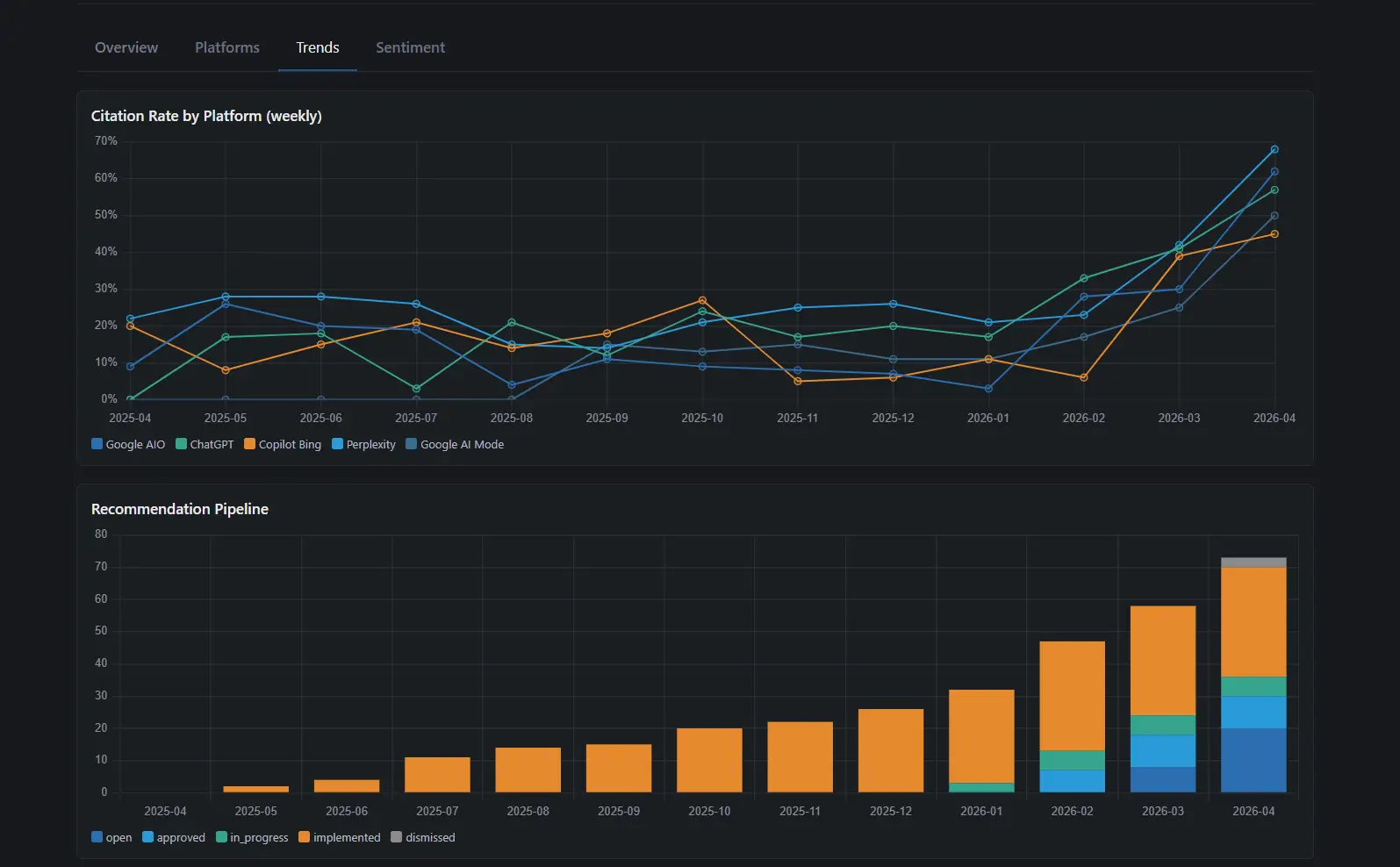
Citation rates trended over time, per platform and overall. Six dashboard charts give you the immediate read: visibility funnel, fix type distribution, citation rate by platform, recommendation pipeline throughput, intent-to-citation conversion, and fix type outcomes.
Time range controls adjust automatically: daily data for short windows, weekly buckets for medium ranges, monthly for long-term trends.
Trending Down
Citation rate has declined across consecutive monitoring cycles.
Stale Content Risk
Your matched page hasn't been updated in longer than the average decay window for this content type.
Competitor Pressure
A competitor has gained citation share on this prompt since the last monitoring cycle.
Know which citations are about to disappear.
Decay Prediction tracks three causal signals per prompt — trending-down citation rate, stale-content risk, and competitor pressure. Any one of them flags a prompt at risk, and a prompt whose citation rate is trending down gets a "runs to zero" estimate: the number of future monitoring cycles before citation rate hits zero at the current trend.
You get a heads-up before the prompt goes silent, not a post-mortem after it does. The signals are causal — each one tells you a different thing about why the decay is happening, so you know which kind of fix to prioritize.
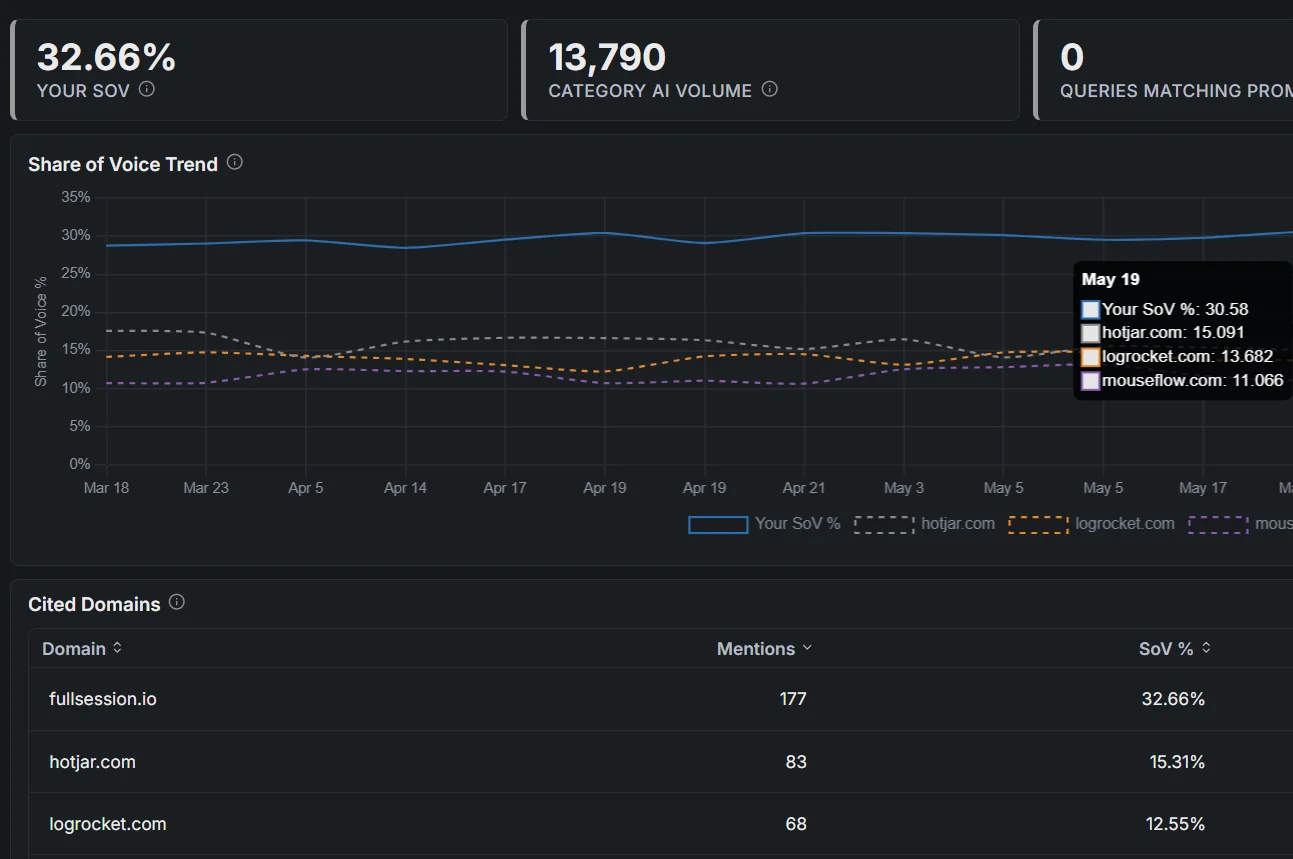
Share of AI Voice — who gets cited when your prompts fire.
LLM Mentions tracks how often your brand appears in AI responses across your monitored prompts — and how that share compares to named competitors. See which domains AI engines co-cite alongside yours, and which ones are displacing you.
Fan-out query discovery surfaces the related queries an AI engine generates internally when answering your tracked prompts — the intent clusters you should be monitoring but aren't yet.
LLM Mentions is available on Pro + Diagnose and above. Full AI Landscape page →
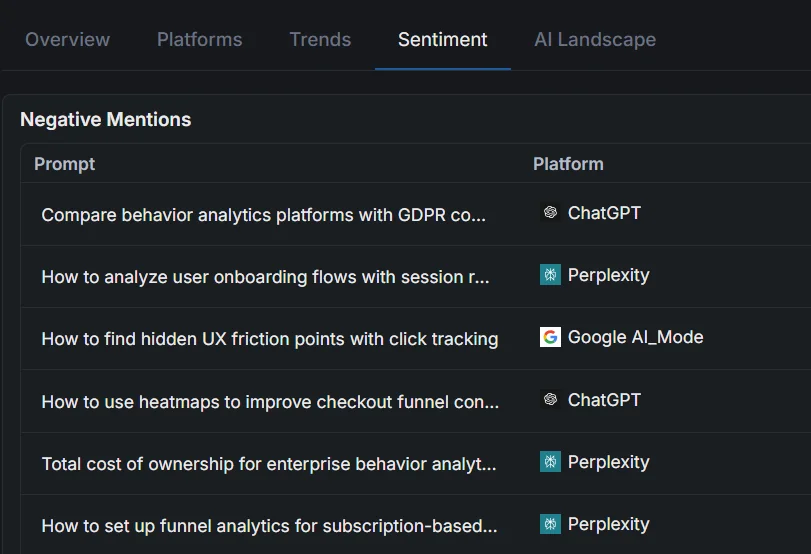
Sentiment — how AI responses frame your brand.
Sentiment analysis classifies every AI response about your brand as positive, neutral, negative, or mixed — per prompt, per platform. Surface negative mention clusters before they compound.
Sentiment is tracked on Watch and above. Full Sentiment page →
Organic and AI visibility. One view.
Connect GSC on any plan, including Free. See impressions, clicks, position, and CTR alongside your AI citation data — with full breakdowns by keyword, landing page, country, and device. Identify pages that rank well organically but aren't being cited by AI — and vice versa.
Measure the traffic AI actually sends you.
Connect GA4 on any paid plan. Track sessions, engagement, and conversions from ChatGPT, Perplexity, and other AI referrers. See which pages receive AI traffic and whether those visitors convert differently from organic search visitors.
Your prompt list gets smarter every month.
Available on Pro + Diagnose and above
Once a month, Rankwize reviews every activated prompt's performance and adjusts its monitoring priority automatically. Prompts that stay silent across several cycles are stepped down — freeing budget for prompts that are producing results — and prompts that earn consistent citations get promoted. Your highest-value prompts are protected: a Gap Alert with a fix recommendation, not a silent downgrade.
You're notified of every change. You can override any automatic decision. The system optimizes your monitoring budget; you keep control.
Frequently asked questions
How does Prompt Discovery work? ↓
Rankwize crawls your domain, extracts a structured fingerprint of your positioning and products, indexes your content library, then generates prompt intents from two sources: proven template families (buying decisions, competitor comparisons, category definitions) and AI ideation for ICP-specific queries. Every intent is scored on four independent factors: demand evidence, citation opportunity, content readiness, and commercial value. High-scoring intents are auto-activated; mid-range intents go to a review queue; low-confidence intents are saved as drafts.
What is Decay Prediction? ↓
Decay Prediction monitors three causal signals per prompt: a trending-down citation rate, stale-content risk (time since your matched page was last updated vs the average decay curve for that content type), and competitor pressure (a competitor recently gained citation share on this prompt). When any of these signals fires, the prompt is flagged at risk; when its citation rate is trending down, Rankwize projects a "runs to zero" estimate — the number of future monitoring cycles before citation rate hits zero at the current trend.
What AI platforms does Rankwize monitor? ↓
Google AI Overviews, ChatGPT, Perplexity, Google AI Mode, and Copilot (5 core engines). Claude is available as an add-on. Gemini is coming soon. Each prompt is run on all enabled platforms every monitoring cycle. Results are kept platform-specific — not aggregated — because the same prompt can be cited on Perplexity and invisible on ChatGPT at the same time.
Does Rankwize integrate with Google Search Console? ↓
Yes, on every plan including Free. GSC integration covers 17 endpoints: impressions, clicks, position, and CTR by keyword, landing page, country, and device. Organic and AI visibility data appear side by side so you can identify pages that rank well organically but are not being cited by AI engines.

“Every AI model answers differently, and we were assuming visibility on one meant visibility everywhere. It didn't. Seeing platform by platform where we got cited, and where we vanished, changed how we prioritize content entirely.”

“I used to keep a folder of screenshots to show my director we appeared in AI results. Now it's tracked over time and I can show the trend, not a lucky moment.”